ART
The ancient art of Ashur is on display in the Louvre, the British Museum, the Pergamon Museum in Berlin, and the Metropolitan Museum in New York City, and other major museums of the world.
Creative works excavated from the burial tombs, palaces and temples of Ashur reveal much about the Assyrian culture. Engraved narrative pieces with realistic depictions of Assyrian life show the dress, horticulture, domesticated animals, entertainment and the activities that were important to the people throughout the first and second millenniums BC. Assyrians collected art from many nations. The remains of such works, as well as the media in which they were created, reveal much about long distance trade and the interactions within these cultures (Feldman, 2006).
In the early days of the Assyrian empire, while Ashur and its contemporaries forged their artistic identity, the influences of several kingdoms including Babylon, Hittite, and Egypt are apparent in creative works. This adoption of artistic style may be a reflection of Ashur’s efforts to obtain the cultural status of brotherhood with such kingdoms. However, when the Assyrians begin to reject the elaborate social protocols of the diplomatic system in place and instead embraced an imperialist ideology, the delicate styles of the kingdoms within the brotherhood were abandoned and the militaristic tradition of Assyrian sculpture emerged (Feldman, 2006). In this way, art served to create narratives of expedition and conquest and helped to normalize such imperial endeavors to the community. As the empire expanded, the primary themes in glyptic and literature became combat. Art was used as propaganda, depicting great victories and acts of war. Assyrian palaces were lined with massive sculptures illustrating the achievements of the resident king. Rather than simply being historical, these works served as military symbols which helped to create a common history and a unified sense of entitlement within the empire (Feldman, 2006).
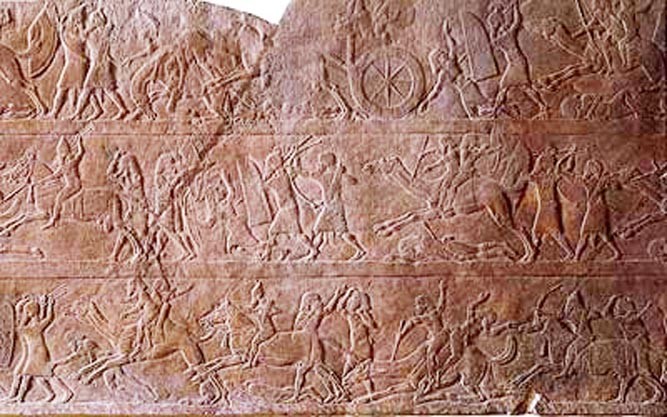
Above: A Mesopotamian copper plate depicting combat.

BURIAL CHAMBERS
Over 1000 inhumations in graves and tombs have been studied. The numerous burials in Ashur, especially during the neo-Assyrian period, allow archaeologists to reconstruct the identity of the culture and provide a broad range of information about the dead and those left behind to mourn. In the article Ashur Tomb 45 and the Birth of the Assyrian Empire, Marian Feldman states, “the material remains, which are often all that we have left today, embodied and made manifest in concrete physical form the relationships, identities, and statuses of an extended circle of interrelated personalities (2006, Burials as Idealized Social Relationships section, par. 1).” Burial goods were deposited for a number of reasons. Some belonged to the deceased and act as a form of self-representation. Others, gifts from mourners, illuminate how the living viewed the dead, while still others have been deemed necessary paraphernalia for success in the afterlife. Such artifacts shed light on Assyrian’s spiritual beliefs (Pearson, 2000 as quoted by Feldman, 2006). Remarkably, in 3000 years these beliefs change only minimally, if at all (Hall & Kirk, 2002).
CUNEIFORM TEXT
Archaeologists discovered thousands of Cuneiform text clay tablets and inscriptions on sculpted wall reliefs. 16,000 of these tablets are now held at the Pergamon Museum in Berlin (Bar, 2003 ). An immense amount of information on the history, politics, economic and legal structure of the Assyrian state, all of Mesopotamia, and the surrounding areas has been ascertained from cuneiform text tablets (Postgate, 1979). During the 16th century, the Dark Ages of the near east, there were almost no written documents in Mesopotamia. Ashur created the majority of the few cuneiform texts that exist,. Information from these tablets is invaluable to understanding that period (Hall & Kirk, 2002). Later tablets emphasize the primary importance of Ashur in both religion and scholarship, especially during the middle and neo-Assyrian periods (Bar, 2003).
