All about Ashur is an educational website created for a class project at Cascadia Community College. The website is about the archeaological site Ashur in modern day Iraq. This website was created by Kyle Mery, Elizabeth Hunter, Hayley Forbes, Thomas Oeun and Michael Dawson. |
||
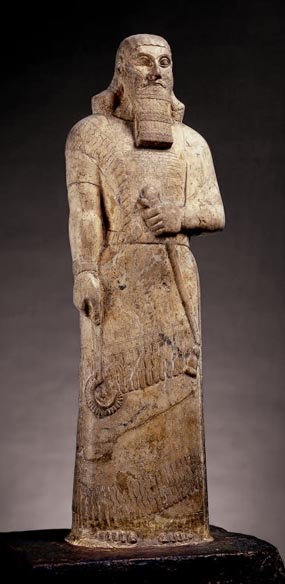 Above: Statue of Ashurnasirpal II. Reigned from 883-859 B.C. |
ASHUR In Mesopotamia, the cradle of civilization, in the middle of the 3rd millennium BC, wedged between the Tigress and Zab rivers and the Makhul mountain ranges, the infant settlement of Ashur nursed itself on an arid farming belt. In a hostile landscape, the culture took root and, with fierce tenacity, endured for nearly three thousand years (Novak, 2004). From an insignificant township suspended on a rocky spur, Ashur became an important trading center for the Akkadian realm. It then grew into a small kingdom and eventually rose to a world empire. In the height of its power, Assyrian influence stretched in every direction. Israel, Babylon, and Egypt all fell under its rule. The systematic brutality of the Assyrian army was immensely successful and its strategies were studied and mimicked by neighboring societies (Hall & Kirk, 2002). Ashur was the first political capital of this empire and remained the religious capital throughout Assyria’s rein. Every Assyrian king was crowned and buried in Ashur. Each metropolis in the empire was more elaborate and complex than the last. But for seven centuries the ground plan, palatial architecture, decoration, monumental art, and furnishings of Ashur were the standard to which each new city aspired (Hall & Kirk, 2002). The Assyrians constructed bridges, roads, and water systems throughout the empire. They produced great libraries, fashioned legal systems and encouraged art and scholarship. When the empire fell, the city of Ashur endured and flourished in the Hellenistic and Parthian periods (Assyrian Kings List, 2010). The site of Ashur, today called zal’at shergat, holds numerous stratigraphic layers of archaeological treasure. It is one of the few multi-period sites of its kind. The following quote was published by ICOMOS (International Council on Monuments and Sites): Ashur is considered the only example of an urban site where continuity and change of the Assyrian civilization pertaining to religious, public and domestic architecture, artistic production, urban planning, religious and political systems, economic subsistence and social patterns is revealed by the archaeological and textual evidence throughout the recorded archaeological periods. (March 2003, Ashur [Iraq] NO 1130 ICOMOS Evaluation, Comparative Evaluation, Par. 1) To learn more about Ashur, visit this link To view a timeline of Mesopotamian history, click this link. |
|
